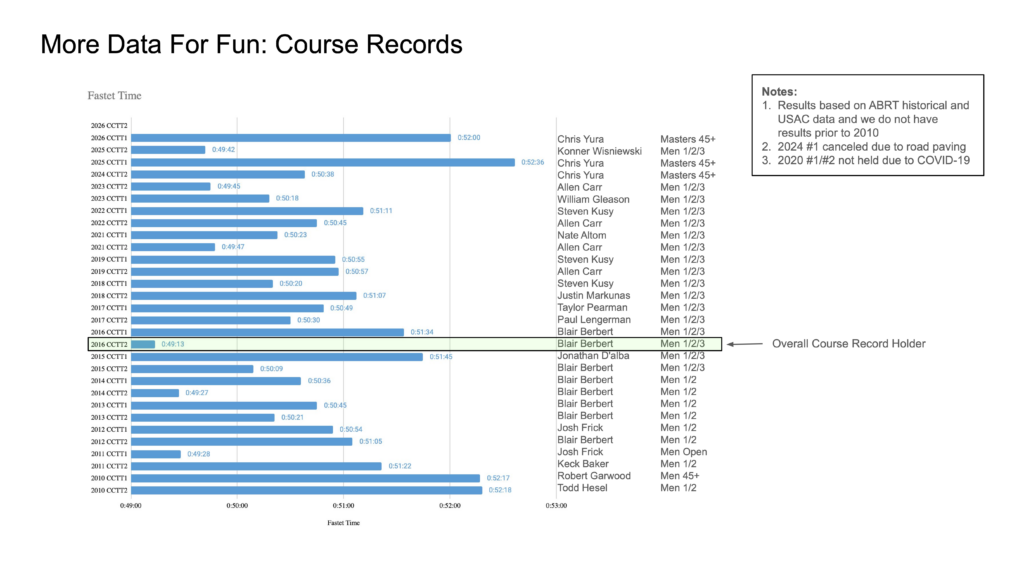
We are currently between the two time trials this year and since we announced this would be the last year, we have had a number of questions both via email and in person at the first event in June about why. We want to take the time now to explain to the cycling community who has supported us over the years the rationale for why we can no longer continue running it. This will be a very frank explanation so people can really understand the issues and as we have said, if anyone believes they can find a way to make it work, we will be happy to share every bit of knowledge we have to help transition it.
This is the 22nd year of the Church Creek Time Trials. The history of how this race came to be is very interesting but too long and inappropriate to tell here. Suffice it to say, for the life of the race since we have been running two Church Creek Time Trials per year, they have never broken even. However, since the beginning we have had an anonymous benefactor that has kept us from being underwater running the two events per year. Sadly this support ended in 2026. It’s a simple fact that the revenue generated from entry fees has never come close to covering the expenses, which have risen significantly, especially over the last 10 years (which we have the best cost data). The fixed costs drivers are timing infrastructure, officials, police/EMT support, and venue support.
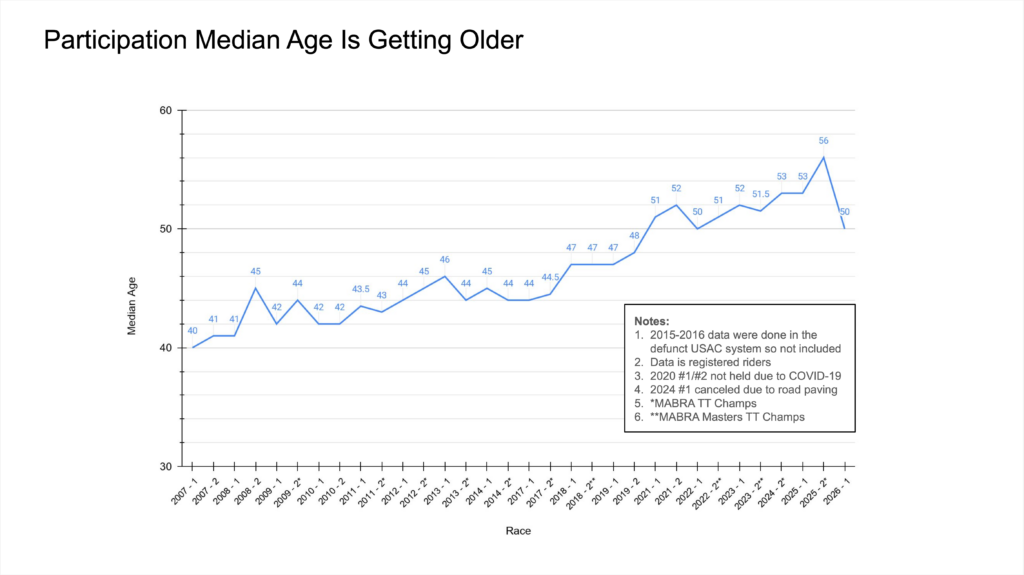
As we all know attendance in competitive (USAC sanctioned) road cycling events has declined over the years and attendance at these time trials tracks with that. The reasons for this decline are many, but there are definitely venue specific issues. This venue is one of the only pure 40k/20k distance, absolutely flat time trials around so is a favorite of time trial specialists and people who like to race against the clock. However, they appear to be a dwindling breed and many people do not like that you have to ride so long from the registration to the start. The weather can be very unpredictable (cold in the spring, oppressively hot in the summer and windy) and it is a long drive for anyone from the Western shore usually with terrible beach traffic. Also, our junior attendance has been very low for a number of years and the median age is significantly higher (masters 75+ is the largest category!). And lastly, the current trend is for people to wait until the latest possible time to register to see what the weather will be. These issues combine resulting in a consistently low turnout. At this point without the sponsorship, we are lately in the red by $2000-$5000 per race.
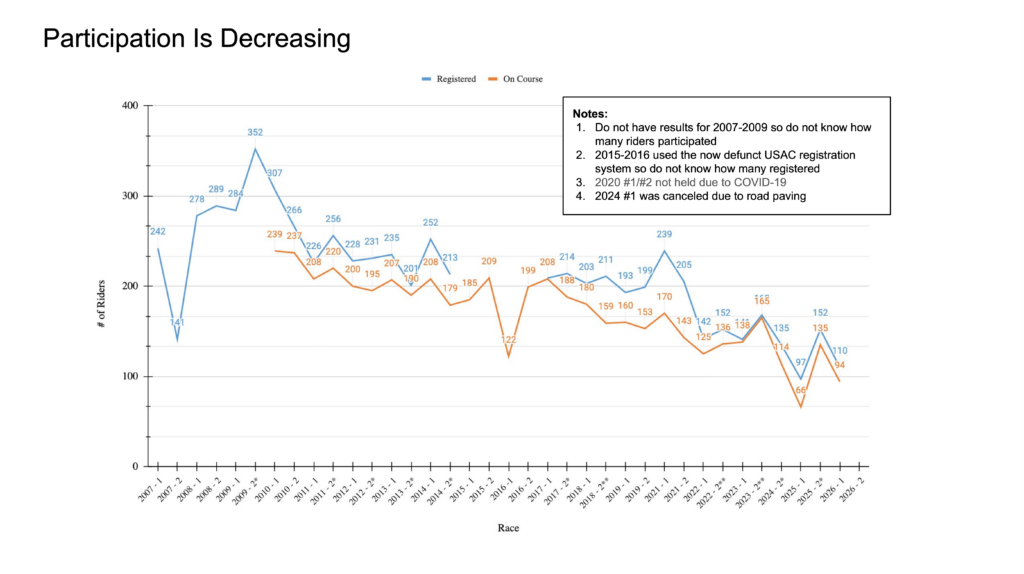
Over the years we have attempted a number of things to increase attendance such as format changes like the non-aero fields, Mixed TTT, Tandems, para athletes, and promotion to non-tradition cycling communities (triathletes, non racers etc). We have also held the entrance fees very low (they have not increased in years) so money would not be a barrier to participation. While these have had some limited success, it just appears that competitive cyclists are not interested in this kind of racing in general and/or this race specifically.
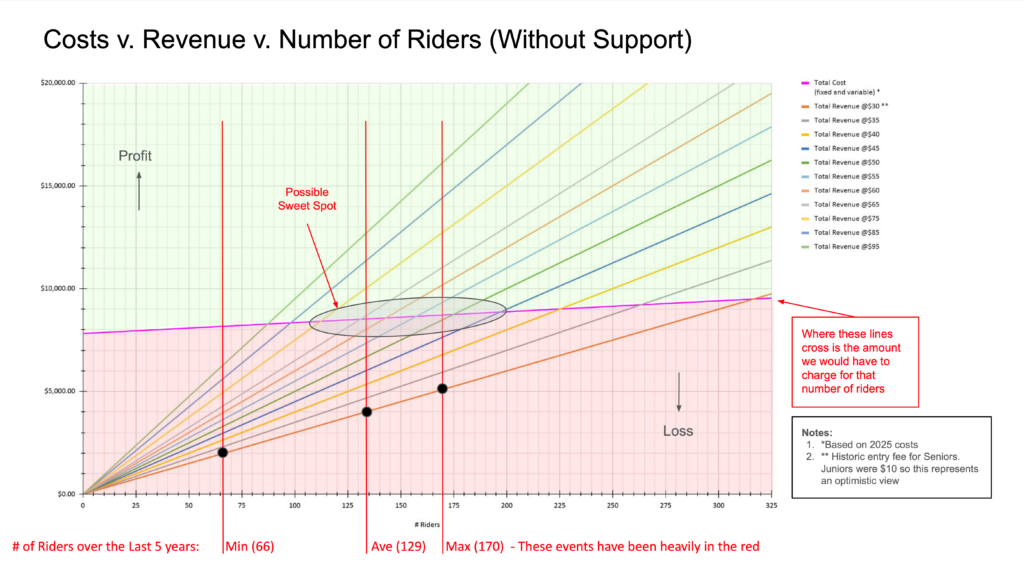
So the numbers just don’t work for the way the race is being run. We have a lot of data from our experiences running this race and put a significant amount of time into analyzing the cost-revenue-number of rider space to see if there were some combination of changes that could make the race work without our historic support. This one graph below shows there is really no combination that works with todays costs.
The way to read the chart is the purple line represents the total costs of single race (based on 2025 data, 2026 was higher!). These costs are made up of fixed costs (timing, police etc as state above) and variable costs per rider (USAC fee, MABRA fee), so they increase slightly with the number of riders, the x axis. Dollars are the y axis. The lines radiating from 0 riders/0 dollars represent the revenues as a function of the number of riders, each line being a specific entry fee. The three dots shown are the minimum, average and maximum number of riders over the last five years. The minimum was last spring when it was cold and wet (few registered/showed up) and the maximum was the first race after the COVID-19 (there was a LOT of pent up demand to get back to racing). We believe these are reasonable lower and upper bounds on attendance looking forward. If anything, they may be optimistic.
The take home is that where the revenue lines cross the total cost line is the number of riders needed to break even. Or conversely, pick a number of riders and and a specific entry fee, if that point is below the total cost, the difference is a loss or if it is above the total cost line, the difference is a profit.
Given the understanding of the cost-revenue-rider model, there are some possible scenarios to get to a break even poing, but none of them look realistic and have some significant cost risk.
Scenario 1: Charge an entry fee that would break even
- Assume average attendance over the last 5 years (129) – very optimistic.
- Large entry fee increase to $65 per rider.
- Still a big exposure to downside risk.
Would the increase in entry fee affect participation? That remains to be seen since we have always kept the entry fee low and don’t know how price sensitive participants are. That is a big unknown. The risk exposure is very large, so even at $65 if the weather looks bad and people don’t end up registering, the potential loss is $2000-$3000 and very unpredictable.
Scenario 2: Get new sponsorship to break even
- Assume average attendance over the last 5 years (129) – very optimistic.
- Modest entry fee increase to $40 per rider.
- Would need $2500 in new sponsorship to break even.
- Still a big exposure to downside risk.
Same assumptions on attendance apply and the assumption is an extra $10 will not affect participation. Where would one come up with $2500 in new sponsorship with essentially zero ROI? In the past MABRA has offered $500 but that is not anywhere near enough and since we had other support, we always turned it down. The same risk exposure as Scenario 1 exists. And lastly,
Scenario 3: Increase participation
- Double participation to 225 riders to break even – unrealistically optimistic.
- Modest entry fee increase to $40 per rider.
- Still a big exposure to downside risk.
The same risk exposure as the prior scenarios 1 exists here, but more importantly, our experience has been there is little that can be done to increase participation to this extent.
All this said, there may be other unknown combinations of assumptions, sponsorship and operational factors that get the event to break even, such as reduce to one event/yr to not dilute attendance (we never tried this because the sponsorship agreement was contingent on 2 events/yr), or even something very out of the box like hold it as a “self serve” virtual race via Strava times and award prizes based on times in a specified window (we thought about this during the COVID-19 pandemic).
So far this discussion just addresses the financial aspect of holding the races. There is the issue of needing people onsite to support the races. ABRT went through a tough period between 2015 and 2018 and as a result, since 2018 we have focused our limited volunteer manpower on our CX race and the increasing difficulty in running that as well as looking into running a MTB XC race as our current membership is largely focused on “dirt riding”. To accommodate this focus shift we partnered with Phase Cycling to staff much of the onsite labor with 1-2 ABRT board members taking the lead and doing all of the administrative work (permitting, BikeReg, medals, police etc) as well as being onsite. Ultimately, labor to run the events in a remote location (compared to teams’ membership) is limited and we essentially paid Phase for that labor. Additionally, if there was money left over, ABRT would realize an operational profit. This profit was a motivation for both teams to continue to work to hold the events. Without that benefit, there is no upside potential, only a large financial risk. We can’t speak for Phase Cycling, but it’s unlikely they would continue to invest their team’s labor without a financial gain.
Perhaps a new operator with new ideas could make it work? Maybe there is some way to mitigate the downside risks via insurance? These are all questions that would need to be answered by anyone looking to take this over.
But in the end, one large existential question is left:
Has this race just run its natural course?
I’m no philosopher so I have to have ChatGPT do it for me:
What gives something meaning when you know it won’t last?

The Church Creek TT clearly mattered because it became more than a bike race. It was tradition, community, shared suffering, shared effort—a yearly ritual that gave people a reason to train, gather, and test themselves.

So if we answer the existential question through that lens. The value of Church Creek was never in permanence. Its value was in the experience it created, the nervous silence in the start gate, the suffering of a 20K or 40K TT and the post-race stories

Those things mattered because they were temporary. The meaning comes from participating fully while they exist. So the answer might be:

"The point isn’t to make something last forever. The point is to build something worthwhile, while you can. Maybe Church Creek ends as an event, but what it represented doesn’t have to."

Everything ends. That doesn’t make it meaningless. It makes it precious. And our responsibility is to honor what mattered by carrying its spirit into whatever comes next.
On that note, we’ll honor the course record holders. The best time to date is held by Blair Berbert from August 2016 at just slight over 49 minutes. There is one last chance on August 22, 2026 to try and beat this record so all you fast time trial specialists have one more shot!